SBS Digital Strategy
From Operational Improvement to Revenue Growth
The baseline when this initiative began
Nine legacy systems, one maintainer, no documented procedures, and spend spread across overlapping vendor platforms — and a workforce carrying the gaps by hand: every order passes through five to ten people over one to five days, with data re-keyed between systems and reports assembled manually before every review.
What success looks like
A unified, governed operating platform: documented workflows, secure auditable automation with human approval on consequential actions, retirement of legacy platforms, and lower recurring cost.
The legacy order workflow — one spot order, ten handoffs
How an order moves today from the account executive to finance. Traffic re-enters the chain three times; nothing is automated between steps.
The human cost of that flow
None of the ten handoffs is automated. Every step depends on a person noticing, remembering and chasing — and the time lost between desks is where the one-to-five-day cycle comes from.
Consequences recorded in the review: slow cross-functional work, avoidable errors, revenue leakage and limited leadership visibility. Hours lost per order are baselined in the pilot before any saving is claimed.
The estate as found
Nine named systems plus a growing stack of digital point tools.
The team & the challenge
One IT director maintains all nine legacy systems alone — deep institutional knowledge, no documented procedures, no AI experience on the team. Disconnected systems, manual data entry and spreadsheets mean slow cross-functional work, avoidable errors, revenue leakage and limited leadership visibility.
The initiative
Started under COO sponsorship (Rich Lara) to put the digital estate in order — systems, staffing, vendors and workflows — and to define what success should look like. Operations depended on one person's memory; there was no auditable way of working; capability already paid for sat underused.
What We Found
Each confirmed issue from the digital review, paired with its business impact and the remedy proposed or completed.
Basis
Digital review findings · TheDash Jira program rationale · LaMusica digital admin access review (LH-SBS series).
| Issue | Business impact | Remedy — proposed or completed | Status |
|---|---|---|---|
| Accountability | No single owner for digital systems and data; decisions stall and shadow processes persist. | Ledger Hub Networks engagement; digital placed under IT oversight with a decision log. | IN PLACE |
| Documentation | Procedures and know-how live with one person; onboarding and continuity are at risk. | Workflow documentation drive and operational runbooks, built into the delivery methodology. | UNDERWAY |
| Controls | Broad admin / root access; no immutable record of who changed what. | Five-gate pipeline (G0–G4), human approval on consequential actions, Urd immutable audit trail. | IN PLACE |
| Fragmented workflows | Manual handoffs across Sales, Finance and Traffic — errors, rework, slow cycles. | Governed automation of lead follow-up, invoicing, reconciliation, approvals, reporting. | PILOT |
| Overlapping platforms | Duplicated spend across vendor tools; licenses paying for the same function twice. | Consolidation evaluation — retain and integrate vs. replace (section 07). | UNDERWAY |
| Underused capability | Paid-for features sit idle; value leaks out of existing contracts. | Capability audit tied to the vendor review; adoption plan per department. | UNDERWAY |
Leadership, AI via NornGate and Accountability
Who decides, who validates, who builds — and how an AI-mediated action gets from request to execution. Changes already implemented are marked IN PLACE; the rest UNDERWAY.
Sponsor — SBS management
Richard D. Lara — COO
Owns the initiative and the decisions of record. Sets priorities, approves scope and investment, and holds the program accountable for cost and revenue outcomes. Every decision on this page is ratified by the sponsor and entered in the decision log.
Oversight — SBS IT
Nelson Santos — IT Director
Expanded role: from sole maintainer of the nine legacy systems to validator and architect of agent workflows. Owns access control, gate policy and data stewardship — nothing The Dash writes into a legacy system passes without his gate rules.
Build & operate — Ledger Hub Networks
Frank Yglesias — CTO
Builder of The Dash. Runs the agent fleet, the five-gate pipeline and the Urd audit trail; delivers integrations, documentation and runbooks under the engagement. Builds to SBS's rules; does not set them.
The LedgerHub engagement
- Scope — a foundation install of The Dash followed by managed operations: LHN monitors, patches, upgrades and migrates models; SBS IT validates.
- Ownership — SBS owns all accounts, domains, repositories and credentials from day one. Nothing is held by the vendor.
- Exit-safe by design — the system is rebuildable from source with full documentation and runbooks, so continuity does not depend on LHN or on any one person.
- Controls — NornGate five-gate pipeline, human approval on consequential actions, immutable audit trail; data stays on SBS-controlled infrastructure.
Nelson's expanded role
- Digital under IT oversight — the LaMusica / Digital estate, previously run outside IT, now reports through IT governance: one access model, one audit trail, one decision log.
- Dash IT — the write gateway Nelson owns. During coexistence the legacy systems stay the systems of record. Nothing the platform originates reaches WideOrbit, CounterPoint, Oracle or ADP except as a write intent that is queued in Dash IT, approved under the risk-tier model, executed, and proven to have landed. Business decisions are adjudicated upstream; Dash IT gates only the technical act of writing the approved outcome. Training and documentation for the transition are in progress.
How a decision flows
The Dash belongs to SBS
The code and IP, including the orchestration core as embodied in the platform, are assigned to SBS in full; LHN keeps only a perpetual, royalty-free license-back for shared components. The platform is not licensed to SBS — it is SBS property, built to SBS's rules. The code base is 100% original authorship with no open-source or forked components in the counted base, which keeps title clean and the asset appraisable by a third-party software valuation.
Intangible asset — ASC 350-40
- Internal-use software — application-development-stage costs (design, build, integration, testing) are capitalizable; preliminary-stage and post-implementation costs (training, maintenance) are expensed; the capitalized asset is amortized over its useful life once placed in service.
- Booking election — management chooses how the asset is recognized: assignment for consideration (booked on the balance sheet) or plain assignment (owned but unbooked, appraisable later). Finance and counsel confirm the treatment — a decision of record, not an accounting assumption.
| Responsibility | Decides | Validates | Executes | Status |
|---|---|---|---|---|
| Program priorities, scope and investment | Sponsor (Lara) | — | SBS IT + LHN | IN PLACE |
| Digital estate placed under IT oversight; decision log opened | Sponsor | SBS IT (Santos) | SBS IT | IN PLACE |
| Gate policy — what agents may do, where a human must approve | SBS IT | Sponsor | LHN (encodes in NornGate) | IN PLACE |
| Access control, credentials and data stewardship | SBS IT | SBS IT | SBS IT | IN PLACE |
| Dash IT write gateway — queue, approve, execute and prove every write into a legacy system of record | Business owner upstream | SBS IT (risk tier) | Dash IT | IN PLACE |
| Agent fleet, integrations, audit trail — build and operate | LHN within policy | SBS IT | LHN | IN PLACE |
| Certification of the eight legacy integrations | SBS IT | SBS IT + department leads | LHN | UNDERWAY |
| Governance close-out — UR-01 to UR-04 | SBS IT | Sponsor | LHN | UNDERWAY |
| Operator-to-validator transition — training, runbooks, documentation | SBS IT | Sponsor | LHN + SBS IT | UNDERWAY |
| Decision log and operating rhythm with management | Sponsor | — | SBS IT | UNDERWAY |
| IP assignment of The Dash to SBS and ASC 350-40 asset recognition — booking election | Sponsor | Finance + counsel | LHN (assignment) + Finance (books) | UNDERWAY |
Already in place
- Phase 1 control plane deployed — week of August 24–28, 2026
- NornGate five-gate pipeline (G0–G4) live — nothing executes until all gates approve
- Urd immutable audit trail logging every action
- LedgerHub engagement active; platform in production behind SSO
- 16 Tier-1 control agents operating on the control plane
- Digital placed under IT oversight; decision log opened
Still underway
- Governance close-out — Update Register items UR-01 to UR-04 (canon re-seal, version propagation, roster lock, approval-dilution fix)
- Nelson's transition from operator to validator — training and documentation in progress
- Decision log and operating rhythm being formalized with management
- Certification of the eight legacy integrations (Phase A)
- ASC 350-40 booking election for The Dash — Finance and counsel to confirm the treatment
The Dash: What It Does Today
Three months in. The platform is in production, the first legacy integration is live, and the beta is rolling out department by department toward its close at the end of Q1 2027.
Live today
- Production platform behind SSO — v2.6.0, SSO and 2FA sign-in
- WideOrbit report feed connected — The Dash pulls WideOrbit reporting directly; the first legacy system is on the platform
- 16 Tier-1 control agents on the control plane, plus the Sales, Finance and Traffic agent layer
- DashSales, DashReports and DashDigital in daily use (sections 05, 06, 09)
- Immutable audit trail — every action logged; data stays on SBS-controlled infrastructure
In beta — closing end of Q1 2027
- Department roll-out in progress — working sessions with Sales, Traffic, Finance, Programming and Digital staff to capture user requirements and shape each workflow
- Remaining legacy integrations — MusicMaster, SIMS, Oracle, ADP, SAP, VCreative, CPT — following the WideOrbit pattern
- Department workflows — lead intake and response, invoicing and reconciliation, follow-up cadences, executive reporting
Next
- WideOrbit retirement — end of Q1 2027; CounterPoint — Q2 2027 (section 07)
- CRM general roll-out to all account executives after the beta (section 06)
- MusicMaster, SIMS and VCreative retirements in the same program; cross-market campaign reporting (section 09)
The Dash in Practice
Three everyday workflows — the current process, how The Dash supports it, and the practical benefit. Aligned with the live demonstration.
| Workflow | Today — manual | With The Dash | Practical benefit | Still manual |
|---|---|---|---|---|
| SalesLead intake & follow-up | Leads arrive by email and spreadsheet; follow-up depends on individual memory. | Agents log, qualify and draft follow-ups for every lead — gated and audited. | Every prospect gets a consistent, faster first response. | AE reviews and sends; gate approval |
| FinanceInvoicing & reconciliation | Re-keying between traffic and accounting systems; month-end matching by hand. | Reads connected systems, matches invoices to orders, flags exceptions. | Fewer errors, shorter invoice and close cycles. | Exception resolution & sign-off |
| OperationsExecutive & campaign reporting | Manual assembly from multiple systems before every review. | Pulls from connected systems and drafts campaign and pipeline reports. | Consistent reporting; live visibility for leadership. | Manager review before sending |
Reporting — what The Dash produces
- Executive reporting — pipeline, bookings and operating status drafted ahead of every management review instead of assembled by hand the night before.
- Campaign reports — delivery and performance per client and per campaign, from live data, as proof of performance for the renewal conversation.
- Cross-market reporting — one view across Chicago, Houston, LA and national, so multi-market packages are reported as one campaign, not four.
- Risk signals — at-risk accounts flagged before renewal; exceptions surfaced from invoicing and reconciliation.
Reporting — where the data comes from
- Connected systems of record — WideOrbit and CounterPoint for orders and traffic, Oracle for finance, ADP for people data, read under the five gates.
- Digital — LaMusica and the digital stack for streaming, podcast and event inventory.
- One source per fact — every figure is traceable to the system it came from; no re-keyed spreadsheets in the chain.
- Live, not periodic — the same report can be drawn today, tomorrow or mid-quarter without a new assembly effort.
Reporting — how it is governed
- Draft, then human review — The Dash drafts; a manager reviews before anything is sent to leadership or a client. Nothing leaves unreviewed.
- Read-only by default — reporting agents read the systems of record; they do not write to them.
- Logged — every report run, its sources and its reviewer are recorded in the Urd audit trail, so any figure can be reproduced later.
- Measured in the pilot — time-to-report and report accuracy against the manual baseline are two of the written success criteria (section 10).
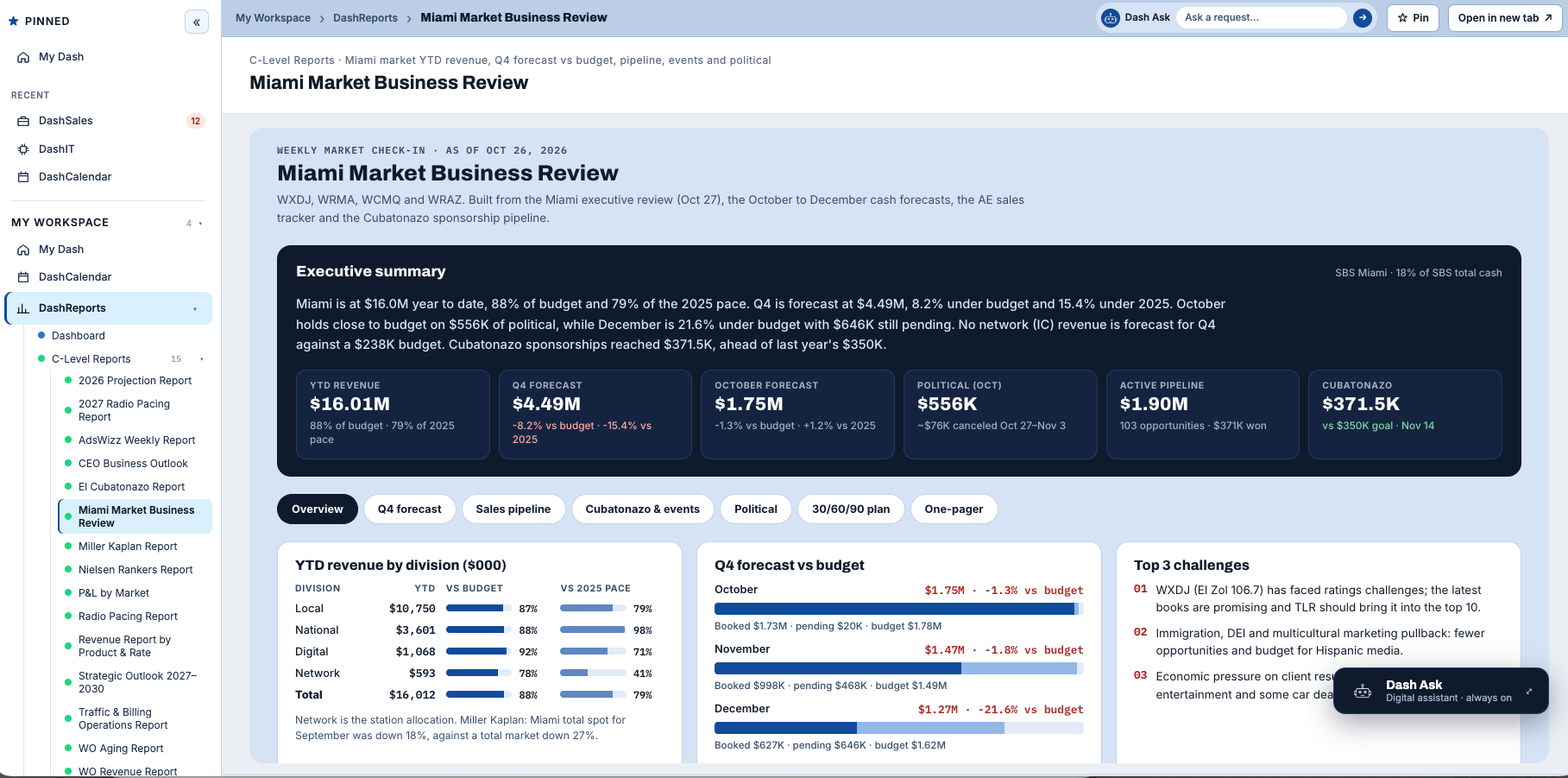
DashReports — a C-level market review, drafted from live data
The Miami Market Business Review as it appears in The Dash: executive summary, KPI tiles, YTD revenue by division against budget and prior-year pace, Q4 forecast by month, and the top challenges — assembled from the executive review, cash forecasts, the AE sales tracker and the sponsorship pipeline, not from a spreadsheet the night before.
CRM and Sales Adoption
CRM through The Dash is in beta with account executives. What is integrated, what is being built with the departments, and what stays in place through the transition.
Integrate
- Account and order data from the traffic system (WideOrbit)
- AE budget and forecast data already kept per market
- Contact and interaction history from existing tools — captured once, reused everywhere
Develop
- Relationship-first CRM model — every contact, account and deal in one structure
- Follow-up cadences and next-best-action guidance for each AE
- Pipeline health and forecast confidence for managers — no more manual roll-ups
Retain
- Proven AE tools during transition — no rip-and-replace
- Existing approvals and client commitments unchanged
- Adoption plan with department champions and training before any cutover
Read this honestly — the data problem comes first
A simpler interface alone will not resolve the underlying data issues. Prerequisites: data hygiene and ownership rules per account, one source of truth, and disciplined entry. The platform enforces the structure — people still supply accurate data. CRM through The Dash is in beta with the departments now; data hygiene and ownership rules are being set with each one as part of the requirement sessions.
What improves adoption
Less admin, more selling — automated summaries, drafts and CRM updates give reps hours back each week; new hires ramp in days in a system that explains itself as they work.
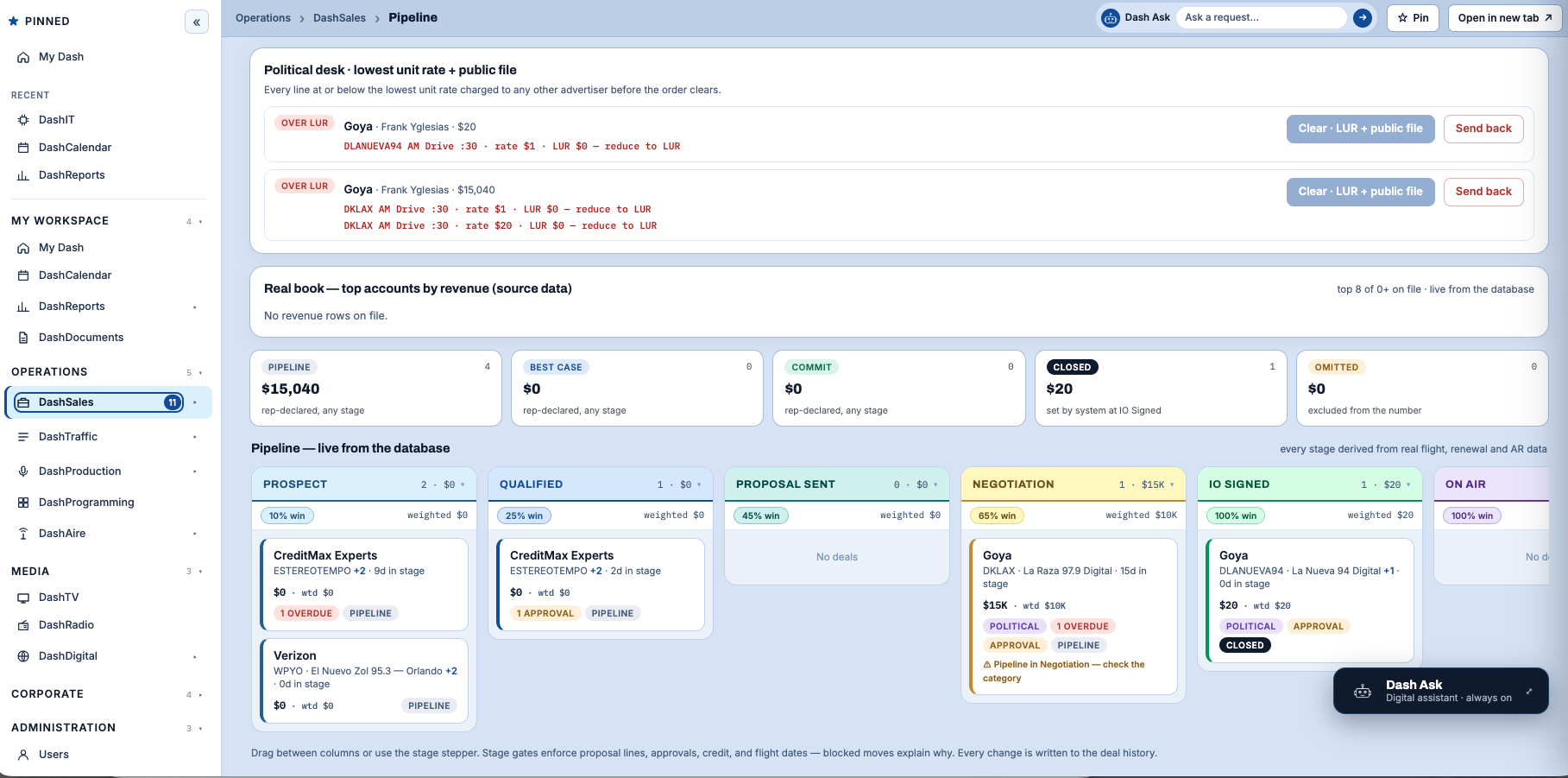
DashSales — the pipeline as it runs today
Live from the database: stage columns with win-weighted value, political-desk LUR checks before an order clears, and stage gates that block a move and say why. Every change is written to the deal history.
Platform Consolidation
Five platforms are being replaced by The Dash on a dated schedule; three systems of record are retained and integrated. The contract review of the five agreements is underway.
Evaluation criteria
Applied to every candidate: feature gaps, data migration, financial and operational controls, support requirements, transition risk. Retirement dates are set: WideOrbit end of Q1 2027, CounterPoint Q2 2027, the remaining three in the same program. Contract review underway (section 08).
| Platform | Role today | Path | Annual cost | Key considerations |
|---|---|---|---|---|
| WideOrbit | Traffic and order management across stations. | REPLACE Workflows transition to The Dash by end of Q1 2027 | $860,000 | Feature-gap review; order-data migration; billing continuity; parallel running to cut transition risk. |
| CounterPoint (CPT) | Traffic and scheduling chain. | REPLACE Same program — by end of Q2 2027 | $90,000 | Interface replacements for daily users; data migration; support continuity. |
| MusicMaster | Music scheduling. | REPLACE Scheduling workflows move to The Dash | $28,000 | Rotation and clock migration; programming sign-off per station before cutover. |
| SIMS | Operations tool. | REPLACE Same program | $45,000 | Data migration; no interruption to daily operations during parallel running. |
| VCreative | Creative production and spot workflow. | REPLACE Creative & Traffic workflows in The Dash | $50,000 | Spot library and approval-history migration; creative team trained before cutover. |
| Oracle · SAP · ADP | Finance and HR systems of record. | RETAIN & INTEGRATE | — | Stay the books of record; The Dash reads and writes under the five gates, with human approval. |
| Recurring subscription cost retired — five platforms | $1,073,000 / yr | Documented contract values; recognized as each contract ends (section 08). | ||
Lower Operating Costs
Five platform retirements are scheduled against documented contract values — $1,073,000 a year once complete. Savings are recognized as each contract ends, starting with WideOrbit at the end of Q1 2027.
| Opportunity | Basis | Owner | Timing |
|---|---|---|---|
| Retire WideOrbit, CounterPoint, VCreative, SIMS and MusicMaster subscriptions | Documented contract values — $1,073,000 recurring annual savings (the $1M+ target): WideOrbit $860,000 · CounterPoint $90,000 · VCreative $50,000 · SIMS $45,000 · MusicMaster $28,000. Contract review underway. | LHN build + SBS IT | WideOrbit by end of Q1 2027 · CounterPoint by end of Q2 2027 |
| Consolidate overlapping digital vendor tools | 2025 Digital Vendor Expenses review — overlap and idle-capability findings. | SBS IT + Finance | With contract review |
| Cut duplicated manual work — re-entry, report assembly | Productivity saving, measured in pilot as hours returned to Sales and Finance. | Department leads | Measured in pilot |
Savings schedule
- End of Q1 2027 — WideOrbit retired: $860,000 / yr
- Q2 2027 — CounterPoint retired: $90,000 / yr
- Same program — VCreative $50,000, SIMS $45,000, MusicMaster $28,000
- Run-rate at completion — $1,073,000 / yr, against an AI running cost under $6,000 / yr on the in-house stack
How This Drives Revenue
Four levers, each with the metric the beta measures against its manual baseline. Baselines are being captured now; results are tracked from the Q1 2027 close.
Better prospect follow-up & conversion
Every lead is logged, qualified and answered — no lead depends on one person's memory. AI-scored leads and tailored follow-up move prospects faster.
Coordinated cross-market selling
One customer view across stations and markets — Chicago, Houston, LA and national — so AEs can pitch coordinated multi-market packages instead of siloed single-station deals.
Stronger digital & event packages
Digital, podcast and event inventory packaged with radio reach into richer sponsorship offers — one inventory story per client instead of separate pitches per channel.
Better campaign reporting & renewals
Fast, consistent campaign reports from live data give clients proof of performance — and risk signals flag at-risk accounts before the renewal conversation.
Beta KPI scorecard — baselines first, then tracked
Baselines are being captured as each department comes onto the beta; results post from the Q1 2027 close and are reported quarterly.
| Lever | Metric | Manual baseline | Beta result | Owner |
|---|---|---|---|---|
| 1 · Follow-up & conversion | Speed-to-lead · conversion rate | capturing | from Q2 2027 | Sales |
| 2 · Cross-market selling | Share of proposals with >1 market | capturing | from Q2 2027 | Sales |
| 3 · Digital & event packages | Package size · attach rate | capturing | from Q2 2027 | Sales / Digital |
| 4 · Reporting & renewals | Renewal rate · time-to-report | capturing | from Q2 2027 | Operations |
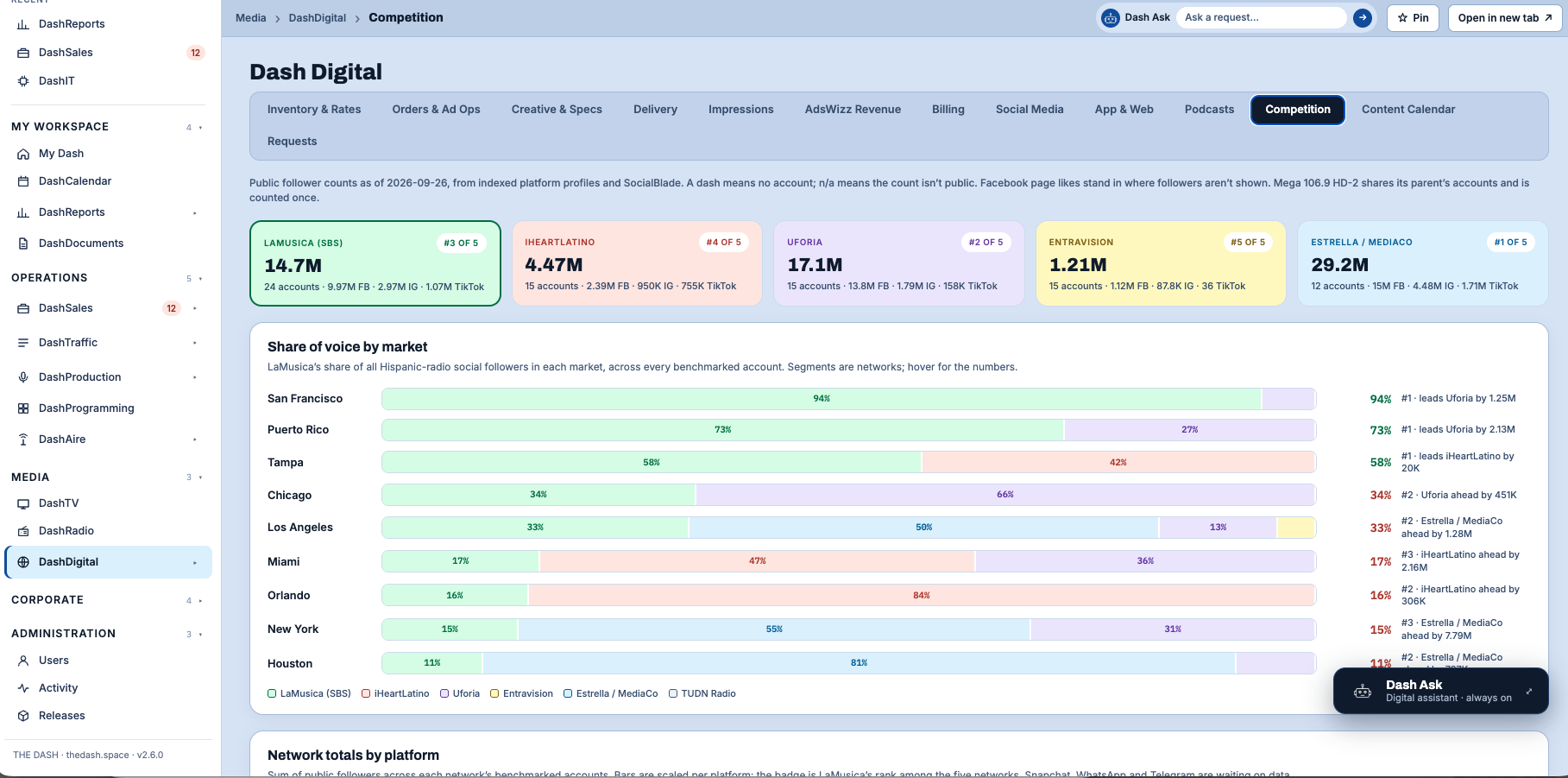
DashDigital — competition and share of voice, market by market
The Competition tab benchmarks LaMusica against iHeartLatino, Uforia, Entravision and Estrella / MediaCo on public follower counts, then shows LaMusica's share of all Hispanic-radio social followers in each market. This is the evidence base for lever 2 (cross-market selling) and lever 3 (digital and event packages): where the audience lead is, where it is not, and by how much.
Roadmap and Status
Approved and in execution since August 2026. The beta closes at the end of Q1 2027; platform retirements follow on the dates below.
Phase A — stabilize & validate
UNDERWAY → CLOSES END OF Q1 2027
- Close governance items UR-01–UR-04
- Certify the eight legacy integrations — readable, writable, governed
- Security hardening; audit-trail verification end to end
- Retire WideOrbit (Q1 2027); CounterPoint, MusicMaster, SIMS and VCreative follow in the same program (CounterPoint by Q2 2027)
Phase B — beta roll-out
IN PROGRESS — PARALLEL RUNNING
- Department-by-department roll-out; requirement sessions with each team; UAT signed off per department
- Sales, Finance, Traffic run daily work through The Dash alongside current processes
- Weekly triage; live demos to management
- Written success criteria tracked weekly against baselines
Phase C — live
LIVE END OF APRIL 2027
- Staged go-live by cohort; internal staff on the platform
- Legacy paths read-only during cutover; WideOrbit retired, CounterPoint in Q2
- Then: CRM general roll-out, remaining retirements, external use
Program status — approved, full steam ahead
- Approved by SBS management; LedgerHub engagement active; platform in production since the week of August 24, 2026
- Beta roll-out under way across Sales, Traffic, Finance, Programming and Digital; closes end of Q1 2027
- User requirements being captured in working sessions with each department's staff and built into the workflows
- WideOrbit report feed linked — the first legacy system reporting into The Dash
- Retirements scheduled — WideOrbit end of Q1 2027, CounterPoint Q2 2027, three more in the same program; contract review underway
Impact: cost — $1,073,000 recurring annual savings at completion (documented contract values) · productivity — hours back to Sales & Finance, measured in the beta · revenue — conversion, cross-market packages, renewals — baselined now, tracked from the Q1 2027 close.